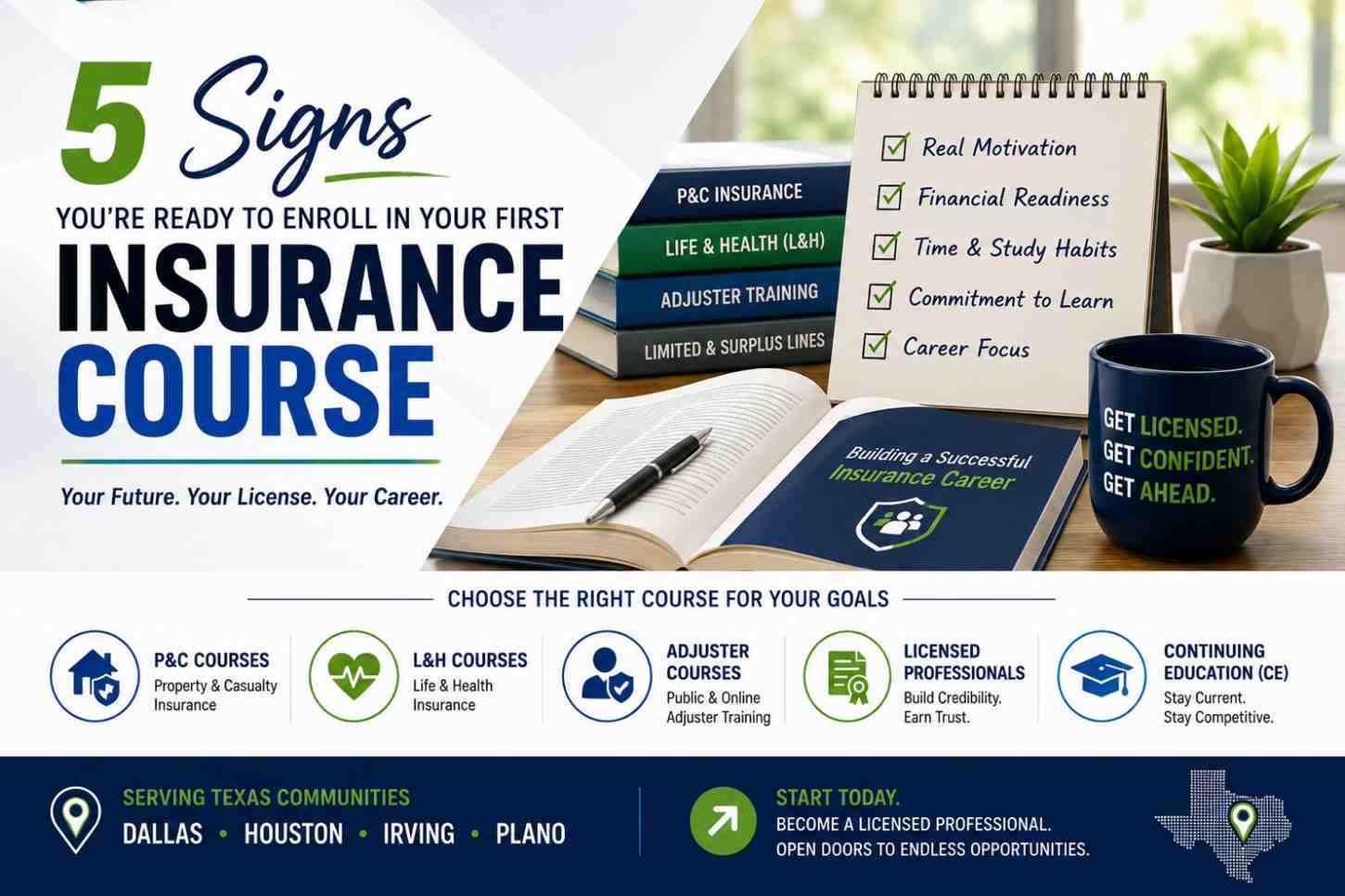
Not sure if you're actually ready to start an insurance career or just thinking about a licensing course? There's a difference. Insurance training programs across Texas run P&C, L&H, adjuster courses (public and online adjuster), limited lines, life only, surplus lines, and continuing education classes, and after years of watching students come through, instructors tend to notice the same five checkpoints in the ones who succeed.
Key Takeaways
● Wanting job security and genuinely caring about helping people usually means your motivation is in the right place.
● Financial readiness isn't about being rich. It's steady income plus treating the course like an investment, not an expense.
● Once you've got both, start researching courses, set a real goal for yourself, and enroll.
Motivation That Fuels Your Commitment
Why you're doing this matters more than people admit. Career change, boredom with your current job, wanting something with a ceiling instead of a dead end, whatever it is, that reason is what gets you through the parts of the course that feel tedious.
The Pull Toward Job Security
A lot of students show up because insurance just doesn't disappear the way other industries do. People always need coverage. If you've got a family depending on you or you're tired of unstable work, a licensing course is a pretty reasonable place to start building something steadier.
A Passion for Helping Others
Then there's the other type of student, the one who actually likes untangling messy situations for people. Helping someone figure out what their policy covers, or walking a family through a claim, isn't glamorous work, but it's real. Pair that instinct with solid licensing course training, and you've got a career that doesn't feel hollow.
Financial Stability: The Backbone of Education
Before signing up for a licensing course, take an honest look at the bank account. Can you actually cover your bills while you're studying? Whether classes are in person or online, the advice is the same: figure out the money side before the excitement wears off.
Keeping a Steady Income While You Train
Most students don't quit their day job to do this. They keep working part-time, sometimes full-time, and study around it. A little financial cushion, or just a flexible schedule, keeps the stress of "how do I pay rent" off your plate while you're trying to learn.
Thinking Like an Investor
Here's the thing worth remembering: these licensing courses cost money now, but licensed professionals with real training tend to out-earn the ones who skipped it. Look at the price tag next to what you'd realistically make afterward. Framed that way, it's less of an expense and more of a bet on yourself.
Are You Ready to Learn?
Motivation and money get you in the door. What happens after that comes down to habits.
Time Management
Juggling a job, a family, and coursework isn't easy, and pretending otherwise doesn't help anyone. Block out real study time and defend it like a meeting. Flexible online and in-person schedules in Dallas, Houston, Irving, and Plano exist because most students are fitting this in around a full life, not the other way around.
Study Habits
Be honest about how you learn. Some people need flashcards and quiet mornings; others need to talk it out loud or watch it explained twice. Figure out what actually sticks, then build around that instead of forcing a method that worked for someone else. Good instructors will help adjust the approach along the way, but students have to know their own patterns first.
Planning Your Enrollment
Once the first four boxes are checked, the last step is just logistics.
Research the Right Course
Insurance licensing course options typically include P&C license courses, L&H license courses, online adjuster courses (public and online adjuster), limited lines courses, life only courses, surplus lines courses, and continuing education classes, online and in person, across Arlington, Dallas, Fort Worth, Garland, Grapevine, Houston, Humble, Irving, Katy, Kingwood, Missouri City, Pearland, Plano, and The Woodlands. Don't just pick the first course you find. Look at how long it takes, how it's taught, and where past students actually ended up.
Set S.M.A.R.T. Goals
Vague goals like "do well" don't hold up when you're tired after a long shift. Give yourself something concrete instead, say, finish the course in six months and score above 80% on your exams. Then break that down into weekly targets, so you always know if you're on pace or falling behind.
Wrapping Up
If the motivation is real, the money side is handled, and the study habits hold up, most people are more ready than they think. Campuses and online licensing courses are available across the state, including Dallas, Houston, Irving, and Plano. Reach out when you're ready to actually start.
FAQ
Q: What signs show I'm ready for my first insurance course?
A: If you want job security and genuinely care about helping people, you're already halfway there. Plenty of students have turned exactly that combination into a solid career.
Q: How do I know if I'm financially ready?
A: You need income steady enough to get through training, and a mindset that treats the course as an investment rather than a cost. Flexible payment options are often available too.
Q: What's the next step after deciding to enroll?
A: Research the course options, set a real goal, and reach out to a program. Campuses and online classes are available in Dallas, Houston, Irving, Plano, and other cities across Texas.