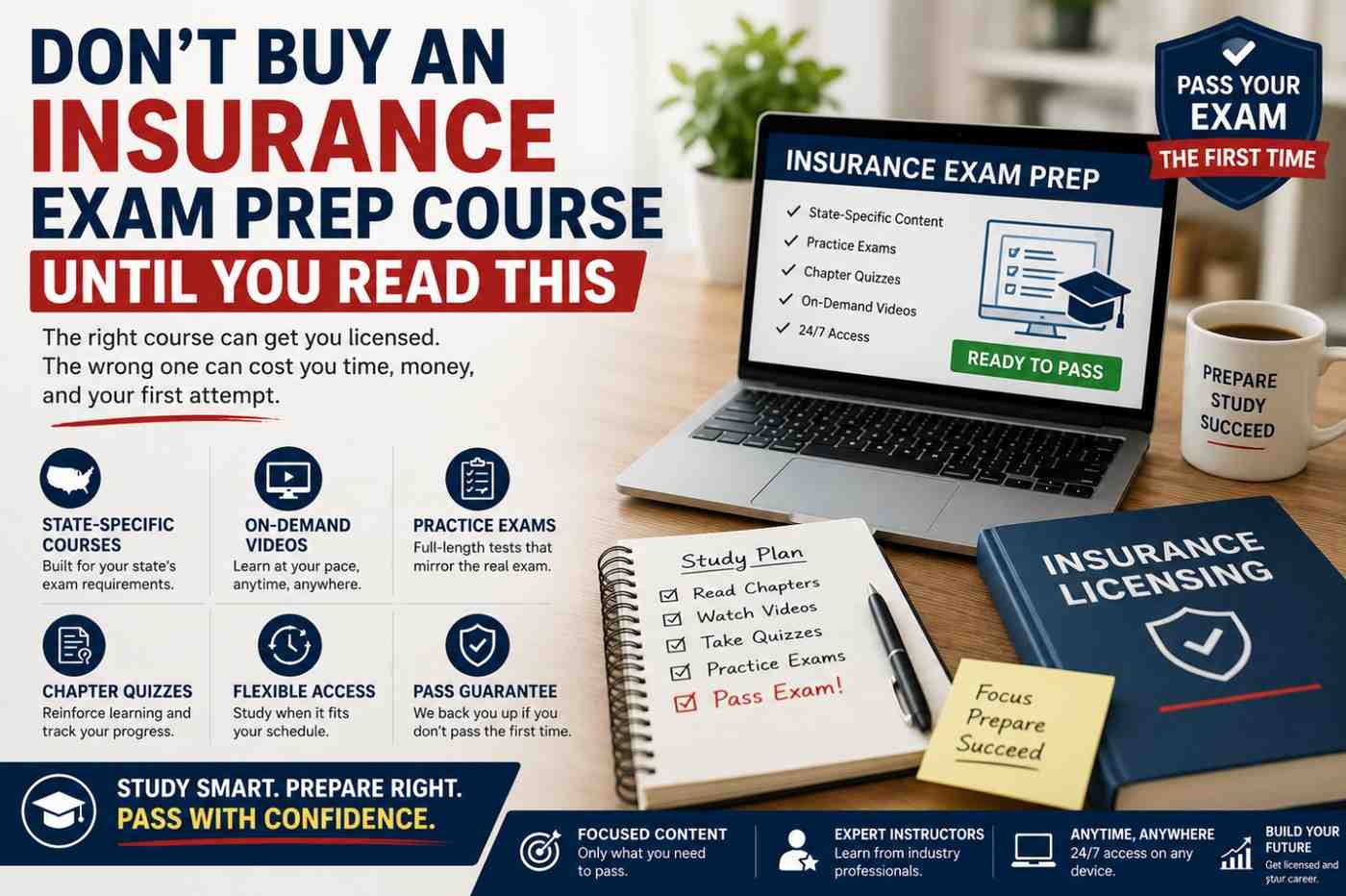
Don't Buy an Insurance Exam Prep Course Until You Read This
So you've decided to get your insurance license. Good move. The industry is growing, the income potential is real, and the barrier to entry, unlike most careers, is a certification exam, not a four-year degree.
Now you're doing what most people do next: searching for an insurance exam prep course.
And that's exactly where a lot of people go wrong. Not because they decided to study. But because they picked the wrong course, wasted their money, and had to start over after failing the exam the first time. It happens more than you'd think.
Before you hand over your credit card, here's what you actually need to know.
The Mistake Most People Make Before They Even Start Studying
Here's the thing nobody tells you upfront: not all insurance prep courses are built equally, and most are not built for your state's exam.
A course might look polished, have great reviews, and cost a reasonable amount. But if the content isn't aligned with your specific state insurance licensing exam, you could spend 30 hours studying the wrong material.
Every state has its own exam requirements. The Property and Casualty exam in one state will not test you on the same breakdown of topics as another. The same goes for Life and Health licensing and Adjuster certification. Generic prep content - the kind that tries to serve everyone - ends up fully serving no one.
This is why state-specific training matters so much.
What to Actually Look For in an Insurance Exam Prep Course
Before you buy, run any course through these questions:
1. Is the content built for your specific state exam?
This is non-negotiable. The course should explicitly state that its modules are aligned with your state's current insurance licensing requirements. Not 'nationwide compatible.' Not 'covers all major topics.' Your state. Your exam. Your content.
2. Does it include simulated exams?
Reading study material is one thing. Actually sitting through a timed, pressured exam is another. A quality insurance license prep course should include full-length simulated state licensing exams that mirror the real test experience. This is how you train your brain for test conditions, not just test content.
3. Are there chapter quizzes throughout?
Good learning is reinforced in stages. Look for courses that include chapter quizzes and practice questions after each module. This keeps you on track, flags weak areas early, and stops you from walking into the exam underprepared.
4. Can you study on your own schedule?
If you're working full-time or juggling family responsibilities, a course with rigid schedules will not work for you. The best online insurance exam prep courses offer 24/7 access through a self-paced learning portal, early morning, late night, lunch break.
5. Are there on-demand videos?
Some people absorb information better through visual instruction than reading. On-demand training videos that walk through concepts can make a real difference, especially for dense topics like policy structures, liability limits, and state-specific regulations.
A Quick Word on 'Cheap' Courses
There's a version of this conversation where someone buys the cheapest course they can find, fails their exam, pays the retake fee, panics, buys a second course, and ends up spending more than they would have on a quality course from day one.
That's not an argument for overpaying. It's an argument for paying for something that works. A good insurance licensing course does not need to cost a fortune. But it does need to deliver on the basics above. If it can't clearly tell you which state's exam it prepares you for, move on.
What About Students Outside Texas?
If you're based in Dallas, Houston, San Antonio, or anywhere else in Texas, you already know that TITA has been preparing students for Texas insurance licensing exams for nearly 13 years with a 90% first-attempt pass rate.
But here's what a lot of people don't know: Texas Insurance Training Academy also offers online exam prep courses for students across the country. If you're in Florida, Georgia, Arizona, California, or anywhere in between, the same exam-focused structure is available to you through their online classes for other states.
Every course includes:
• State-specific study modules built around your actual exam
• Chapter quizzes and practice questions throughout the course
• On-demand training videos you can revisit anytime
• Full-length simulated state licensing exams
• Flexible 24/7 access so you study when life allows
• Complete exam prep from start to finish - no filler, no overlap
How Long Does It Actually Take?
Most students spend between 20 and 25 hours in the course before they feel ready to schedule their exam. That's roughly three to four weeks if you put in an hour a day, or faster if you can dedicate more focused time on weekends.
It's manageable. And with a self-paced structure, you control the timeline.
The Bottom Line
Getting your insurance license is one of the more accessible career moves available right now - but only if you prepare with the right material. The wrong course costs you time, exam fees, and momentum.
Before you buy anything, ask the hard questions. Is the content specific to your state? Does it include real practice exams? Can you study on your schedule?
If you're ready for a course built to get you to pass, not just get you enrolled - start with Texas Insurance Training Academy's online courses and see exactly what's waiting for you on the other side of that exam.
Ready to get licensed? Explore self-paced, state-specific insurance exam prep at texasinsurancetrainingacademy.com