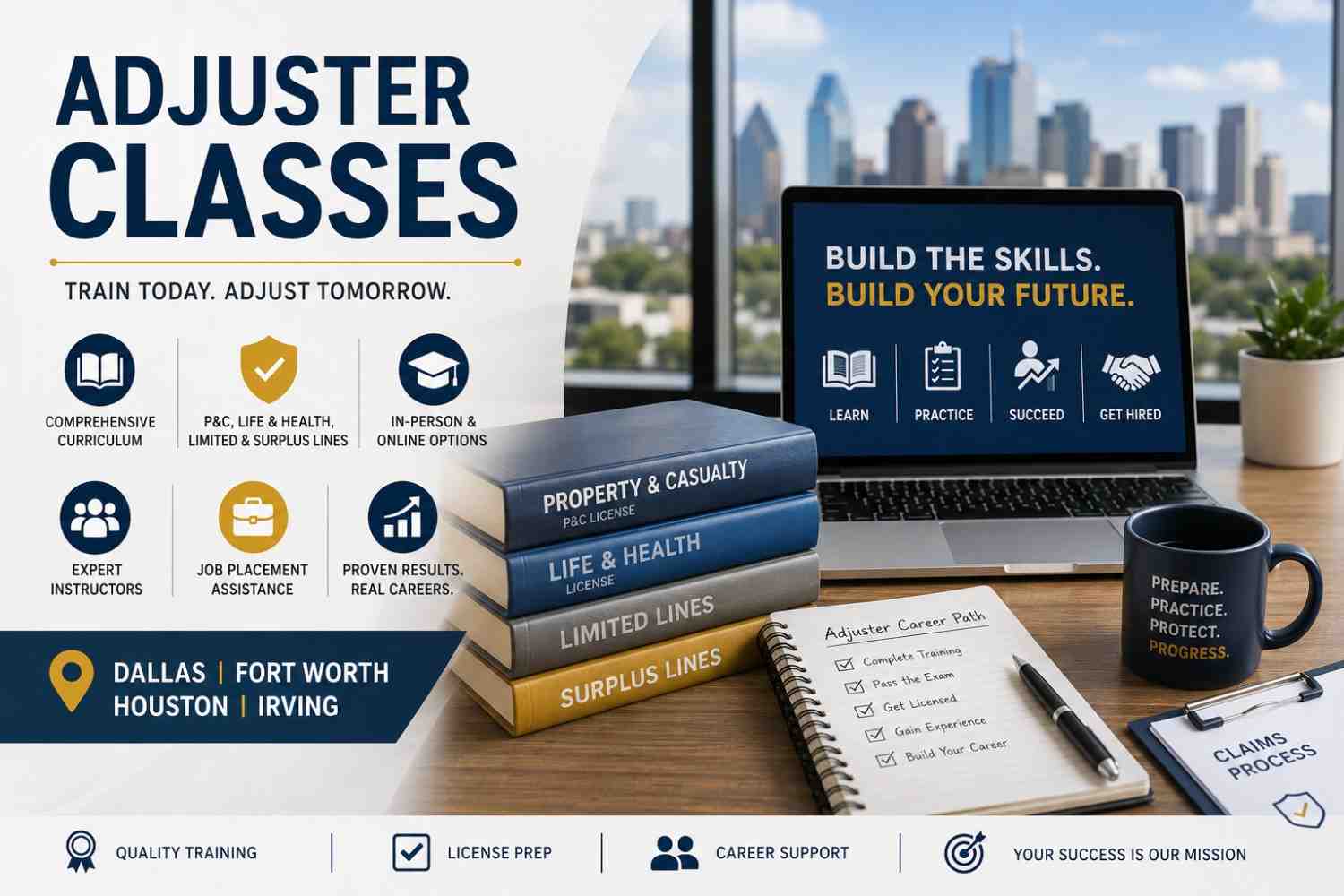
Picking the right adjuster classes isn't just paperwork before you sit for an exam. It's the foundation for everything that comes after: how confident you feel walking into your first claim, how fast you get hired, and honestly, how much you enjoy the work. So whether you're going for a P&C license, Life and Health, or something more specialized like Limited Lines or Surplus Lines, the program you choose matters more than most people realize going in.
A few things worth checking before you enroll:
-
Does the adjuster classes curriculum actually go deep, or does it skim the basics?
-
Are the instructors credentialed, and better yet, have they worked claims themselves?
-
What do the pass rates and job placement numbers actually look like?
A curriculum that covers more than the exam
The best adjuster classes don't just teach you to pass a test. They cover insurance principles, claims handling, and risk management, sure, but they also spend real time on negotiation, communication, and conflict resolution, because that's what the job actually looks like once you're in it. Insurance adjuster courses built around insurance law, ethics, and current regulations give you something to stand on. And if there's hands-on practice built in, even better. That's usually where things actually click.
Instructors who've done the job
There's a noticeable difference between an instructor teaching from a textbook and one who's actually adjusted claims. The ones with field experience bring stories, shortcuts, and hard-won lessons you won't find in course material, things like how to handle a difficult client or negotiate a settlement that both sides can live with. They also tend to become the first contacts in your professional network, which matters more than people expect early on.
Finding a format that fits your actual life
Not everyone learns the same way, and that's fine.
Classroom settings work well if you like structure and want to ask questions in real time. You get face-to-face feedback and sometimes access to equipment or simulation labs you wouldn't get otherwise.
Online courses are built for flexibility. Study at midnight if that's when you have time, replay a lecture you didn't fully catch, keep working your current job while you train.
Hybrid programs split the difference: in-person for the hands-on stuff, online for theory. If you want some structure but can't commit to a fixed schedule, this is usually the sweet spot.
Texas Insurance Training Academy runs P&C, L&H, and Public and Online Adjuster courses, plus Limited Line, Life Only, and Surplus Lines options online, along with Continuing Education classes. So there's room to pick whatever path actually fits your goals.
The numbers that actually tell you something
Pass rates matter, but dig a little further than the headline number. A program might post strong overall pass rates while quietly underperforming on a specific exam, like workers' comp. Ask.
Job placement is another one worth pressing on. Adjuster classes with real employer relationships and support like resume help or interview prep tend to get their graduates hired faster. Ask what kinds of roles recent grads landed and what they're earning.
And don't discount satisfaction. If former students are willing to vouch for a program, that usually means something.
Getting real value out of your training
Sitting through lectures passively won't get you far. Ask questions. Push back when something doesn't make sense. Work through case studies and simulations instead of just reading about them, because that's where the material actually sticks.
Networking happens naturally in a good program: guest speakers, industry events, instructors who introduce you around. None of that shows up on paper, but it opens doors. And when you get the chance to apply what you've learned, like working through a mock claim with real policy details, take it. That's the closest thing to job experience you'll get before you're actually hired.
Licensing is the start, not the finish
The industry doesn't sit still. New regulations, new technology, shifting best practices- it's constant. That's why Continuing Education isn't just a box to check; it keeps you relevant.
Certifications like the CISR or CIC can set you apart when you're going for a promotion or a new role. And staying plugged into industry publications, webinars, or professional groups means you're reacting to change before it becomes a problem instead of after.
Where to find it in Texas
Texas Insurance Training Academy serves students across Dallas, Fort Worth, Houston, and Irving, with both in-person and online options across P&C, L&H, adjuster, limited lines, life only, and surplus lines licensing, plus continuing education credits.
FAQ
What should I look for in a training program?
Full curriculum coverage, instructors with real claims experience, current industry standards, and actual hands-on practice, not just lecture time.
How do I know if a program is actually good?
Pass rates, job placement numbers, and what former students say about it. Industry partnerships help too.
How do I get the most out of my training?
Show up engaged, build relationships with instructors and classmates, apply what you're learning right away, and don't stop at your first license; certifications like CISR or CIC keep paying off.