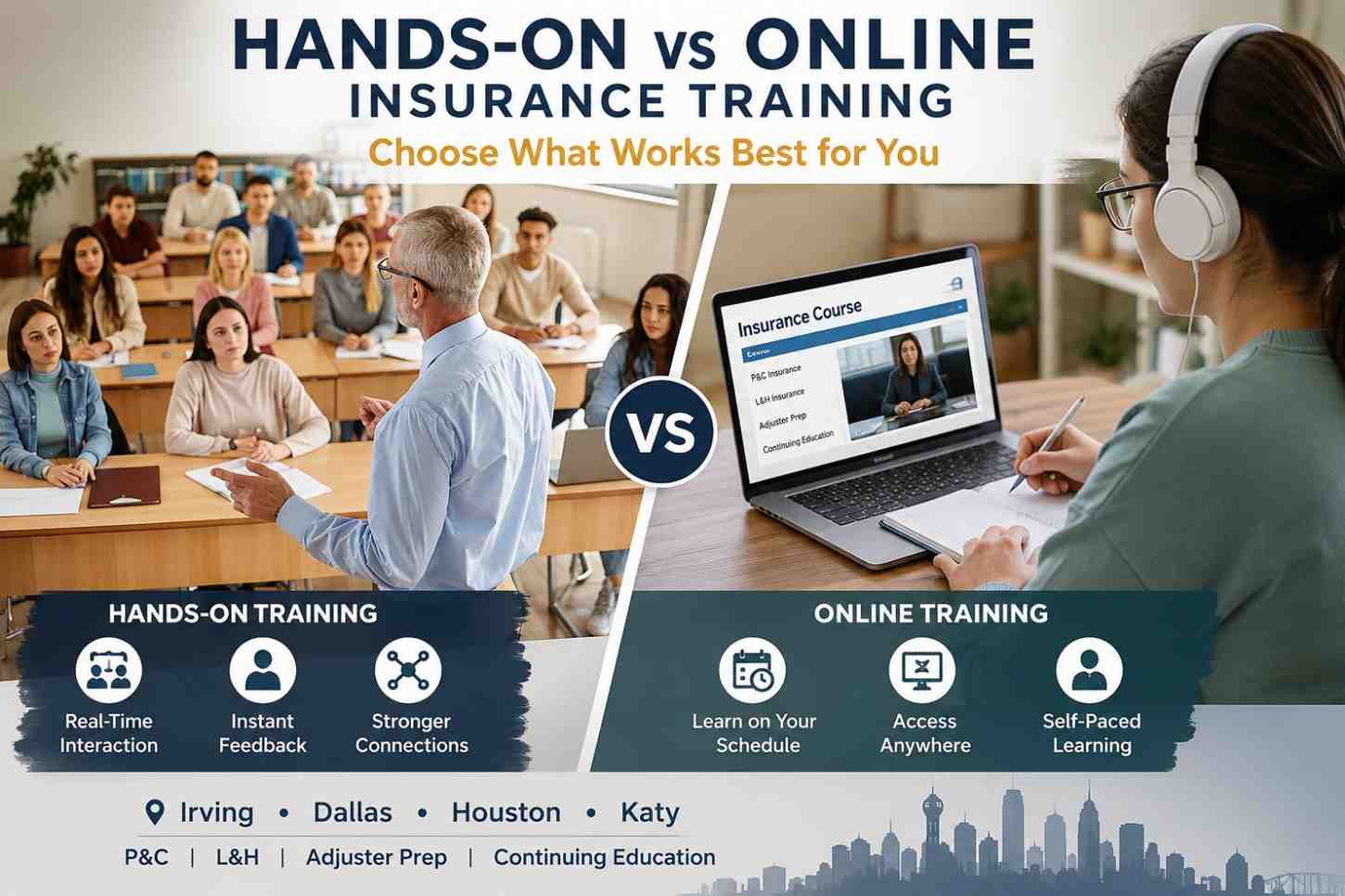
If you're getting ready to start your insurance career, you've probably run into the same question a lot of students ask: should you go for hands-on training or take your classes online? Most insurance schools now offer both formats across the full course lineup: Property and Casualty, Life and Health, adjuster courses (public and online adjuster), limited line, life only, surplus lines, and continuing education, so students in Irving, Houston, Dallas, and Katy can pick the format that fits their life.
The Case for Hands-On Training
Hands-on training puts you directly in front of an instructor, working through real scenarios instead of just reading about them. You get to practice things like handling a claim, explaining a policy, or walking through a tricky regulation, and you get corrected on the spot instead of finding out weeks later that you misunderstood something.
This format works best for visual and kinesthetic learners, people who need to see it and do it before it clicks. Role-playing a claims conversation or working a case study with classmates builds a kind of muscle memory that reading alone doesn't give you, and because instructors are right there, you're never stuck waiting on an email reply. For students in Houston or Dallas who want face-to-face structure, in-person sessions can make dense material feel a lot less overwhelming.
The Case for Online Training
Online training solves a different problem: time. If you're working a full-time job, raising a family, or juggling both while trying to get licensed, hands-on class schedules aren't always realistic. Online courses let you log in whenever it works for you, whether that's early morning before work or late at night after the kids are asleep.
You also get to move at your own pace. Struggling with a section on surplus lines or continuing education requirements? Rewatch it. Feel confident about a topic? Move on. This self-paced setup is especially useful for auditory learners who do well with recorded lectures, and it's a big reason students in Katy and across greater Houston lean toward online formats when schedules are tight.
Matching the Format to How You Actually Learn
Most people fall into one of three learning styles: kinesthetic, visual, or auditory. Kinesthetic learners, roughly 15% of people, need to physically do something to absorb it, so hands-on labs and role-play matter a lot to them. Visual learners, around 65%, respond well to diagrams and video walkthroughs. Auditory learners, about 20%, do best with spoken explanations and narrated lessons they can replay.
Neither format is universally "better." A visual learner might thrive with an online course full of animated explainer videos, while a kinesthetic learner might struggle without an in-person component to practice with. Knowing your own style before you enroll saves you from wasting time on a format that fights against how your brain actually works.
Why Hybrid Training Is Gaining Ground
A growing number of students are skipping the either-or decision entirely and choosing hybrid programs instead. Hybrid training lets you complete coursework online at your own pace, then attend in-person sessions to practice what you've learned and get feedback in real time. It's a practical middle ground: you keep the flexibility that makes online training doable around a busy schedule, but you don't lose the hands-on practice and instructor access that makes concepts stick.
For students spread across Irving, Dallas, Houston, and Katy, hybrid options are often the easiest way to fit licensing coursework, whether that's P&C, L&H, adjuster prep, or continuing education, into an already full week.
Making Your Decision
There's no single right answer here. If you want interaction, immediate feedback, and a structured environment, hands-on training is worth the schedule commitment. If flexibility and self-paced learning matter more to you, online training will probably serve you better. And if you want both, a hybrid path might be the smartest way to go.
Whatever direction you choose, the goal is the same: getting properly licensed and ready to work in the insurance industry, on a timeline that actually fits your life.
FAQ
Q: What's the biggest advantage of hands-on insurance training over online classes?
A: Real-time interaction. You get immediate feedback from instructors and the chance to practice scenarios like claims handling or client conversations face-to-face, which helps concepts stick faster for visual and kinesthetic learners.
Q: How does online training accommodate different learning styles?
A: Online courses offer self-paced modules, recorded lectures, and repeatable content, which works well for auditory and visual learners who want to review material on their own schedule rather than in a fixed classroom block.
Q: How do I decide between hands-on, online, or hybrid training?
A: Start with your learning style and your schedule. If you need structure and face-to-face practice, go hands-on. If flexibility matters more, go online. If you want both, a hybrid program combining self-paced coursework with in-person practice is usually the best fit.