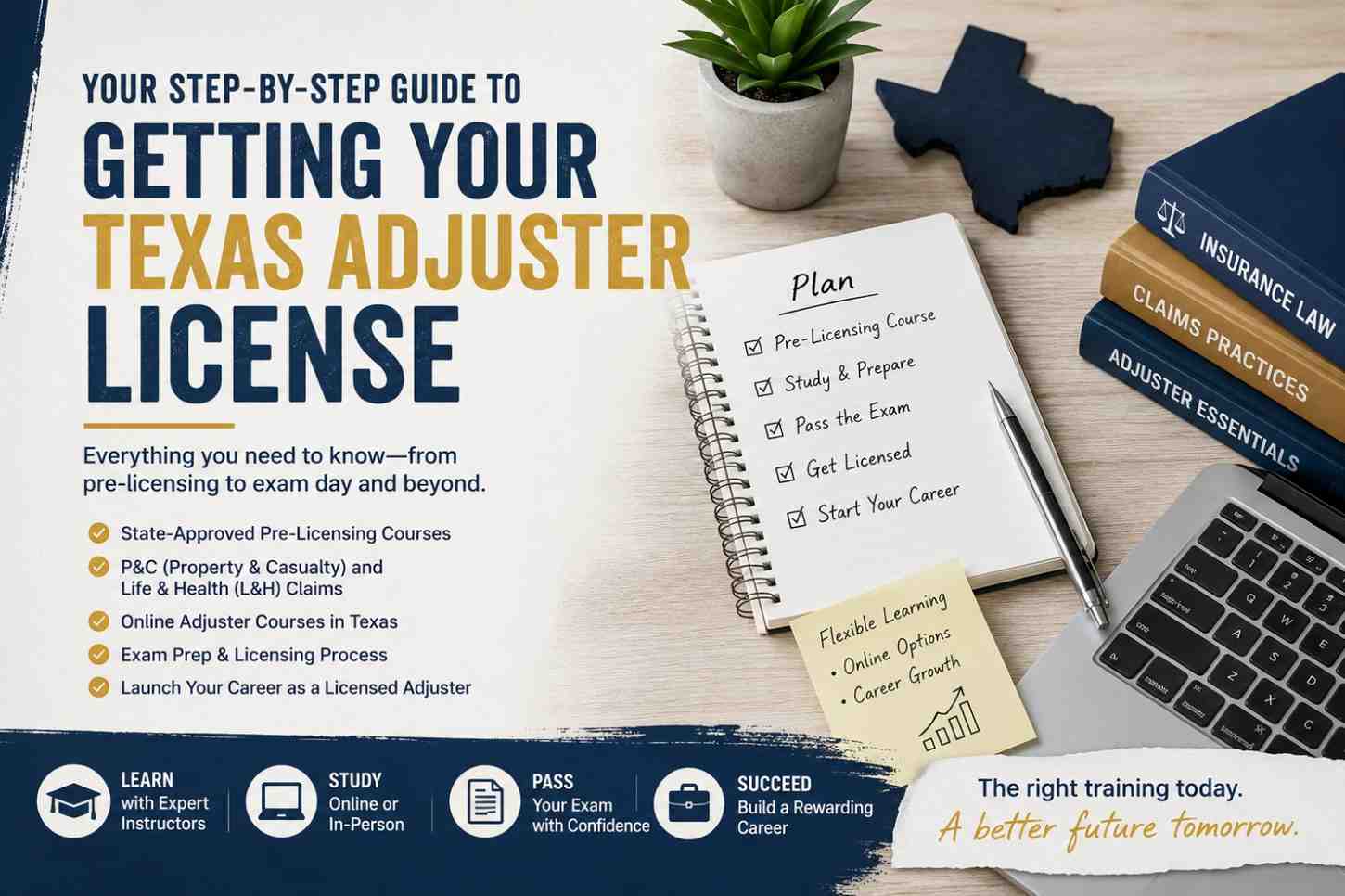
So you've decided to get your Texas adjuster license. Good move. Now comes the part where you actually figure out what that involves: prerequisites, coursework, an exam, and a bit of patience while your background check clears.
The good news is the path doesn't change much no matter where you're starting from; Dallas, Houston, Fort Worth, or Plano all follow the same basic steps. Meet the requirements, finish a state-approved pre-licensing course, sit for the exam. Most people who prepare properly pass on the first try and are working claims within a few weeks.
What Is a Texas Adjuster License?
It's the credential that lets you legally investigate, evaluate, and settle insurance claims in Texas, on behalf of either the insurer or the policyholder. Depending on which track you go with, that can mean property and casualty (P&C) claims, life and health (L&H) claims, or something more specialized.
Who Needs It and Why
Independent Texas adjuster license, staff adjuster, catastrophe adjuster doesn't matter which. If you're touching claims in Texas, you need this license first. That's the case whether you're out working storm damage in Houston after hurricane season, handling routine property claims in Dallas or Fort Worth, or slowly building your own client base in Plano. Texas already has over 10,000 licensed adjusters on record with the Department of Insurance, and that number's only climbing as insurers keep growing their claims teams. Once you're licensed, you can work directly with insurers, adjusting firms, and policyholders, and actually get paid to help people through a claim.
Benefits of Getting Licensed
This isn't a one-lane career. You can go independent, join a firm, or specialize in property damage, liability, workers' comp, whatever fits. Pay varies a lot, but licensed adjusters typically land somewhere between $50,000 and $100,000+ a year depending on experience. And beyond the paycheck, having the license just tells employers you're not starting from zero. You're trained, you're credentialed, you're ready to work.
Steps to Obtain Your License
A few boxes to check before you can even apply.
Prerequisites
You need to be 18 or older, have a high school diploma or equivalent, and be able to prove Texas residency with a driver's license or state ID. There's also a background check involved, fingerprints and all, and that part usually takes a few weeks to come back. Start it early so it's not the thing holding you up.
Course and Exam Process
Next up: 30 hours minimum of approved pre-licensing coursework covering insurance law, ethics, and how claims adjusting actually works. Plenty of online adjuster courses serve candidates around Dallas, Houston, Fort Worth, and Plano, so scheduling shouldn't be the obstacle it sounds like. Once that coursework's done, you're cleared to take the state exam: 150 multiple-choice questions, 70% to pass, 2.5 hours on the clock. You can sit it in person at a testing center or remotely with an online proctor, whichever works better for you.
Why the Right Training Partner Matters
Here's the thing nobody tells you upfront: not every pre-licensing course actually gets you ready. The provider matters. Look for online adjuster courses in Texas built around real scenarios and the actual exam content, not some generic course that could apply to any state.
Industry-Approved Curriculum: Ensuring Relevance and Rigor
A good curriculum keeps pace with Texas insurance law and teaches to what the exam covers, not a watered-down version of it. That rigor pays off later too, because the critical thinking you build studying is the same thinking you'll use adjusting a fender-bender in Arlington or storm damage outside Houston.
Accelerated Course Structures: Learning at Your Own Pace
Nobody's life pauses for exam prep. If you're working full-time in Fort Worth or juggling family stuff in Plano, self-paced online courses let you fit studying around your actual schedule instead of the other way around. Worth checking whether a program also covers P&C and L&H adjuster courses, limited line and life-only online courses, surplus lines training, and continuing education classes so you're not switching providers every time your license needs something new.
Conclusion
None of the ‘Texas adjuster license’ thing has to be complicated. Handle the prerequisites, get through your coursework, take the exam seriously, and you'll be ready to start claims work anywhere in the state- Houston, Dallas, Fort Worth, take your pick. Pick a training provider with a solid pass rate and formats that actually fit your life, and you'll get from "thinking about it" to "licensed adjuster" faster than you'd expect.
FAQ
Q: What is a Texas Adjuster License and who needs it?
A: A state-issued certification required for anyone assessing or settling insurance claims in Texas, which includes independent, staff, and catastrophe adjusters.
Q: What are the steps to obtain a Texas Adjuster License quickly and affordably?
A: Meet the prerequisites, complete 30 hours of approved coursework, pass the state exam. A flexible online course can cut real time off that timeline.
Q: How do I know if a training course will actually prepare me for the exam?
A: Check whether the curriculum is built around the actual Texas exam content outline, with practice questions and real instructor support, not something generic.