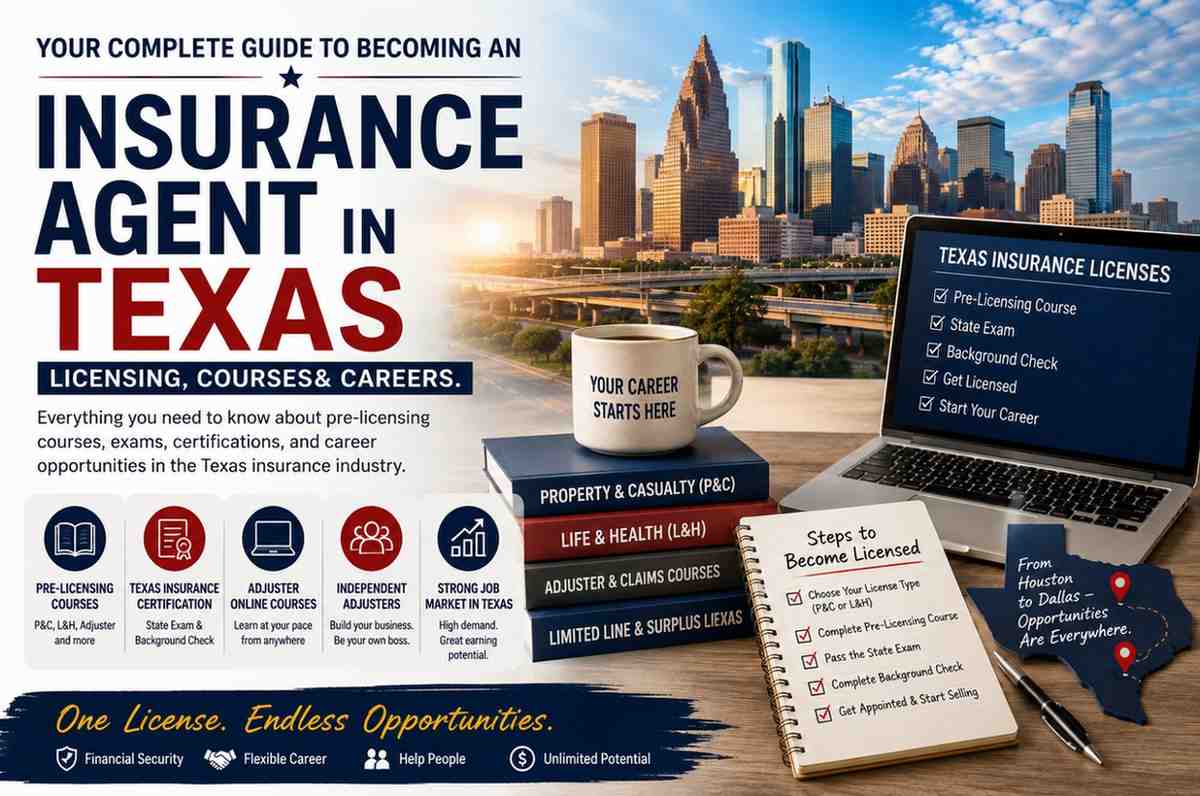
Want to work as an insurance agent in Texas? You'll need a Texas insurance license first. Here's what that actually takes.
Key Takeaways
Becoming a licensed insurance agent in Texas means completing a pre-licensing course, passing the state exam, and submitting your application.
The field keeps growing, and licensing rules exist to keep agents qualified.
Texas sets specific pre-licensing hour requirements and a background check, both detailed on the Texas Department of Insurance website.
Online courses for P&C, L&H, adjuster, limited line, life only, surplus lines, and continuing education make exam prep easier to fit into a busy schedule.
Once certified, you can step into entry-level roles or start building toward long-term specializations.
The Imperative of Getting Certified in Texas
Your Texas insurance certification is what sets you apart in a crowded field. Over 100,000 licensed agents already work statewide, from Houston to Dallas, so proving your expertise matters more than just showing interest. The Texas Department of Insurance website walks through the certification process, and once you're licensed, doors open into specialization areas like life and health insurance or underwriting.
The Competitive Job Market for Insurance Agents
The insurance job market in Texas isn't easy to break into, especially around Dallas, Fort Worth, and Houston. You'll need more than a license to stand out: a real grip on insurance principles, current regulations, and how to talk to people. The Bureau of Labor Statistics projects steady growth, and agents with solid training tend to earn better pay.
Specific Licensing Regulations You Need to Know
The Texas Department of Insurance regulates every licensed insurance agent in Texas, and what's required depends on the license type. Life insurance candidates usually need 40 hours of pre-licensing coursework; property and casualty candidates need 60. There's more than just P&C and L&H, too: adjuster online courses for public and independent adjusters, a limited line online course, a life-only online course, surplus lines online courses, and continuing education classes to keep an existing license active. Reciprocal agreements with other states exist, but state-specific rules still apply.
Navigating the Licensing Process: Your Roadmap to Success
The process itself is fairly straightforward: pick a pre-licensing course, pass the exam, then submit your application. Life and health candidates typically need 200 hours of instruction, while property and casualty runs 300. Depending on your pace, the whole thing can take anywhere from a few weeks to a few months.
Selecting the Right Pre-Licensing Course
A good course comes down to reputation, a schedule that actually fits your life, and instructors who show up when you need them, whether you're studying from Katy, The Woodlands, or somewhere else in Texas. Practice exams and published pass rates are worth checking before you commit; they tell you more than the hour count does.
Mastering the Texas Insurance Exam
There's no substitute for steady practice. The exam mixes multiple-choice questions with scenario-based cases, testing whether you can apply what you learned, not just recall it. Prometric runs the exam, with a set time limit and a minimum score to pass. Breaking your studying into smaller chunks and running timed quizzes tends to help more than one long cram session.
Completing Your Application and Background Check
Once you've passed, you'll submit your application, get fingerprinted, and go through a background check, which can take a few weeks. Have your exam results, proof of residency, and course certificate on hand so nothing holds things up. Once approved, your license comes through, and you're ready to work with clients anywhere in the state.
Exploring Online Learning Options for Insurance Certification
Studying online means fitting coursework around work and family instead of the other way around. Lectures, quizzes, and practice exams are all available from your laptop or phone; no commute to a classroom needed, whether you're in Arlington, Grapevine, or Irving.
Advantages of Flexible, Remote Learning
Self-paced study lets you go back over anything confusing as many times as it takes. Online courses also tend to run cheaper and skip the commute altogether, which matters if you're studying out of Missouri City, Pearland, or Plano.
Why Candidates Choose Online-First Training
Insurance agent in Texas courses built around video lectures, practice exams, and real access to instructors tend to see better pass rates, mostly because people engage with the material instead of skimming through it.
Preparing for the Journey: What Certification Entails
Most courses run two to six months and cover insurance principles, ethics, and Texas-specific rules, along with the study materials and practice exams you'll need along the way.
Understanding Course Structure and Duration
Expect the coursework to dig into life, health, property, and casualty insurance, plus how policies and claims actually play out in practice. Real examples and case studies do a lot of the heavy lifting, backed up by video lectures and quizzes.
Leveraging Study Tools and Exam Preparation Resources
Practice exams, flashcards, and instructor support all help you spot weak areas before exam day, not after. Simulated tests get you used to the exam's format and timing, which cuts down on the stress that trips people up.
Unlocking Career Potential After Certification
Once you're certified, entry-level roles open up across agencies, brokerages, and insurance companies, in places like Fort Worth, Humble, or Kingwood. From there, it's really about whether you want to specialize early or build broad experience first.
Entry-Level Roles Awaiting New Agents
New agents usually start as sales reps, customer service reps, or claims adjusters, learning the ropes alongside people who've been doing this a while. Job boards help, but local networking tends to open more doors.
Long-Term Career Development and Specialization Opportunities
With a few years behind you, designations like Chartered Life Underwriter become an option, or you might move toward underwriting, risk management, or running your own practice. Continuing education keeps your license active as the rules shift over time.
Summing Up
Getting an insurance agent in Texas isn't complicated: pick the right pre-licensing course, pass the exam, and get your application in. The job outlook holds up well, and certification gives you a real path into entry-level work now and specialization down the line.
FAQ
Q: What's the first step to getting licensed in Texas?
A: A pre-licensing course that meets Texas Department of Insurance requirements, whether that's P&C, L&H, adjuster, or limited line.
Q: How long does the process take?
A: Courses usually run 20 to 40 hours depending on license type, and background checks add a few more weeks after the exam.
Q: What are the benefits of studying online?
A: You get to learn at your own pace with practice exams and instructor support, no matter where you're based, from Dallas to The Woodlands.
Q: What career paths open up after certification?
A: Entry-level sales or claims work to start, then underwriting, risk management, or agency leadership as you build experience.