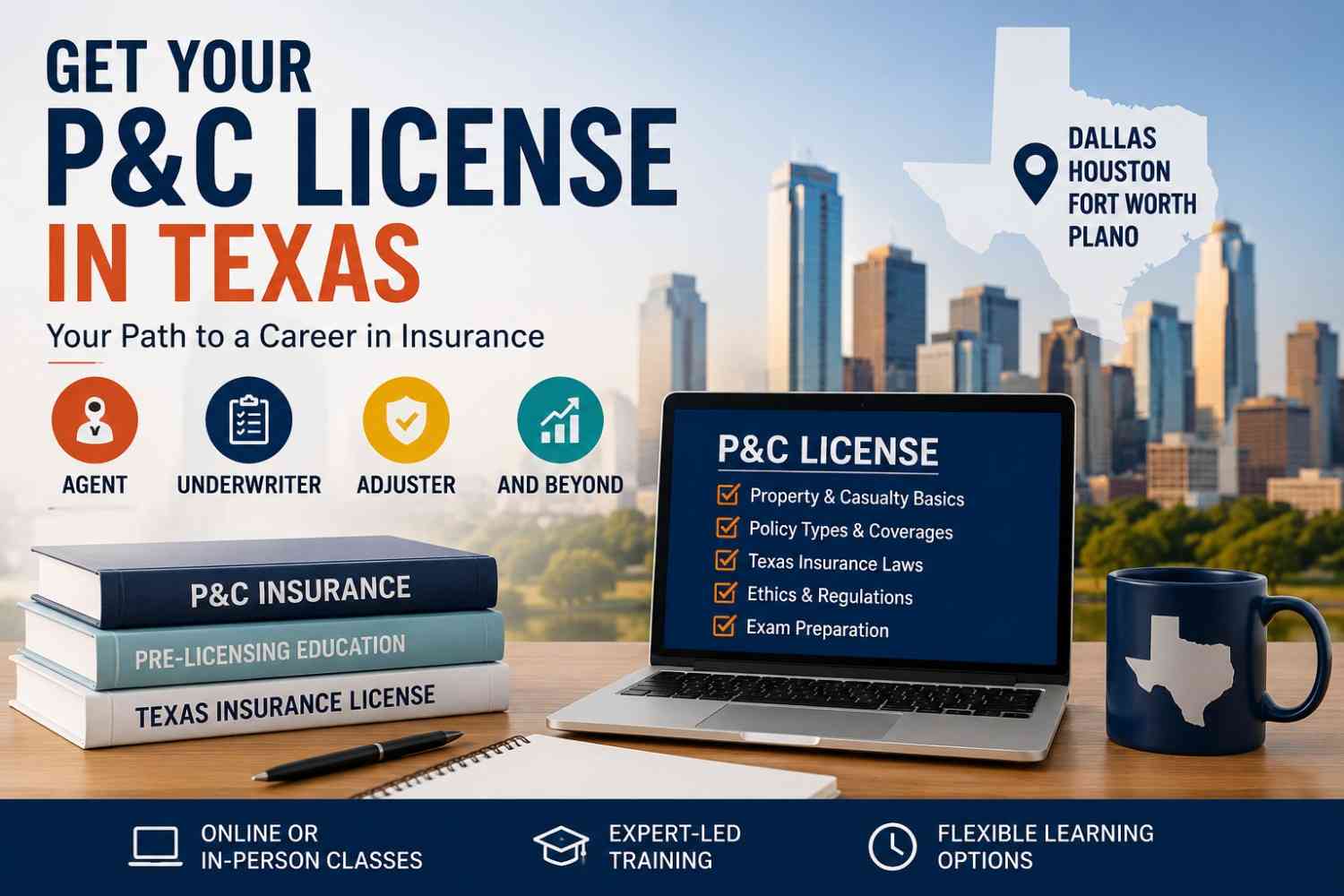
Thinking about a career in property and casualty insurance? The fastest way is picking the right training and not overthinking the rest. Whether you're eyeing a full P&C license, an L&H track, or something narrower like adjuster licensing, most of the confusion people run into comes down to not knowing the process upfront. Here's what actually matters.
Key Takeaway
-
The licensing process, career options, and continuing education rules are the real foundation here. Everything else is detailed.
-
Pick a training program based on accreditation and pass rates, not just price.
-
P&C license isn't the only route. Public adjuster work, limited line credentials, life-only licensing, and surplus lines all lead somewhere different.
What P&C insurance actually covers
At its core, P&C insurance covers liability, workers' compensation, and commercial property, plus a handful of other lines depending on the specialty. A business owner usually needs liability coverage in case of a lawsuit. A homeowner needs something different: coverage against damage to the property itself. Knowing the difference is basically the job.
And it's not purely transactional either. People buying this coverage are usually trying to protect something they've worked hard for. Agents who get that, who don't just recite policy language, tend to keep clients longer.
Where this career can actually go
A Texas insurance license opens more doors than people expect:
• Agent or broker, selling and servicing policies day to day
• Underwriter, figuring out risk and pricing
• Claims adjuster, either a public or online adjuster tracks
• Specialist roles in cyber, flood, or surplus lines
If you'd rather not commit to a full agent path right away, an online adjuster course or a limited line credential lets you get specific faster. And if L&H interests you more than a pure P&C license, a life-only course is worth looking into before you commit to anything bigger.
What Texas actually requires
Getting licensed in Texas comes down to three things: finish your pre-licensing education hours, pass the state exam, and keep your license active through continuing education afterward. None of it is complicated, but skipping a step (or letting continuing ed lapse) is the easiest way to lose ground you already earned.
What you can expect to earn
Pay depends heavily on role, experience, and where you're based, but there's real room to grow. Agents, brokers, underwriters, and adjusters land anywhere from around $50,000 to well over $100,000, and specialization tends to push that number up. A designation like the Chartered Property Casualty Underwriter (CPCU) is one of the more reliable ways to do that.
Picking a training program without wasting money
A few things worth checking before you hand over a card number:
Accreditation. If a program isn't recognized by a legitimate accrediting body, that's a red flag, not a minor detail.
Format. Online works if your schedule is unpredictable. In-person works if you actually learn better with a live instructor and people around you. Neither is objectively better, it depends on you.
Pace. Some programs move fast, others are built for people working full time. Be honest about which one fits your actual life, not the one that sounds more ambitious.
Support. Career counseling and job placement help matter more once you're through the material and trying to land something real.
Getting through the exam
Once pre-license training's done, the state exam is really the only thing standing between you and a license. What tends to help:
• Know the format, question count, and time limit before you sit down
• Use a study guide that actually maps to what's tested, not a generic one
• Take practice exams under real timed conditions, not casually
• Go back over what you got wrong instead of just moving on
Leave yourself enough time before the actual exam date. Rushing into it rarely goes well.
After you're licensed
Passing the exam is the start, not the finish line. Most people land their first role through some combination of a tailored resume, actual networking (industry events, associations like the National Association of Insurance Professionals), and outreach on LinkedIn to recruiters who work in this space specifically.
Longer term, continuing education keeps your license valid, and it's also a natural point to specialize: surplus lines, cyber, whatever fits where you want to go next.
Finding classes near you
Insurance licensing courses are available across Texas, including Dallas, Houston, Fort Worth, and Plano, both online and in person. Whether you're going for a full P&C license, an L&H license, or something more specific like a surplus lines or limited line credential, picking a program that actually fits your schedule matters more than picking the biggest name.
FAQs
What's the first step to getting a P&C license in Texas?
Pre-licensing education. That's where you learn policy types, coverage basics, and the Texas-specific rules you'll be tested on.
How do I know if a training program is actually good?
Check accreditation first, then format, course length, scheduling, and whether they offer real support once you're studying, not just when you're signing up.
What can I realistically expect to earn?
Somewhere between $50,000 and $100,000+, depending on the role and how much you specialize. Adjusters and underwriters with a few years in tend to land on the higher end.