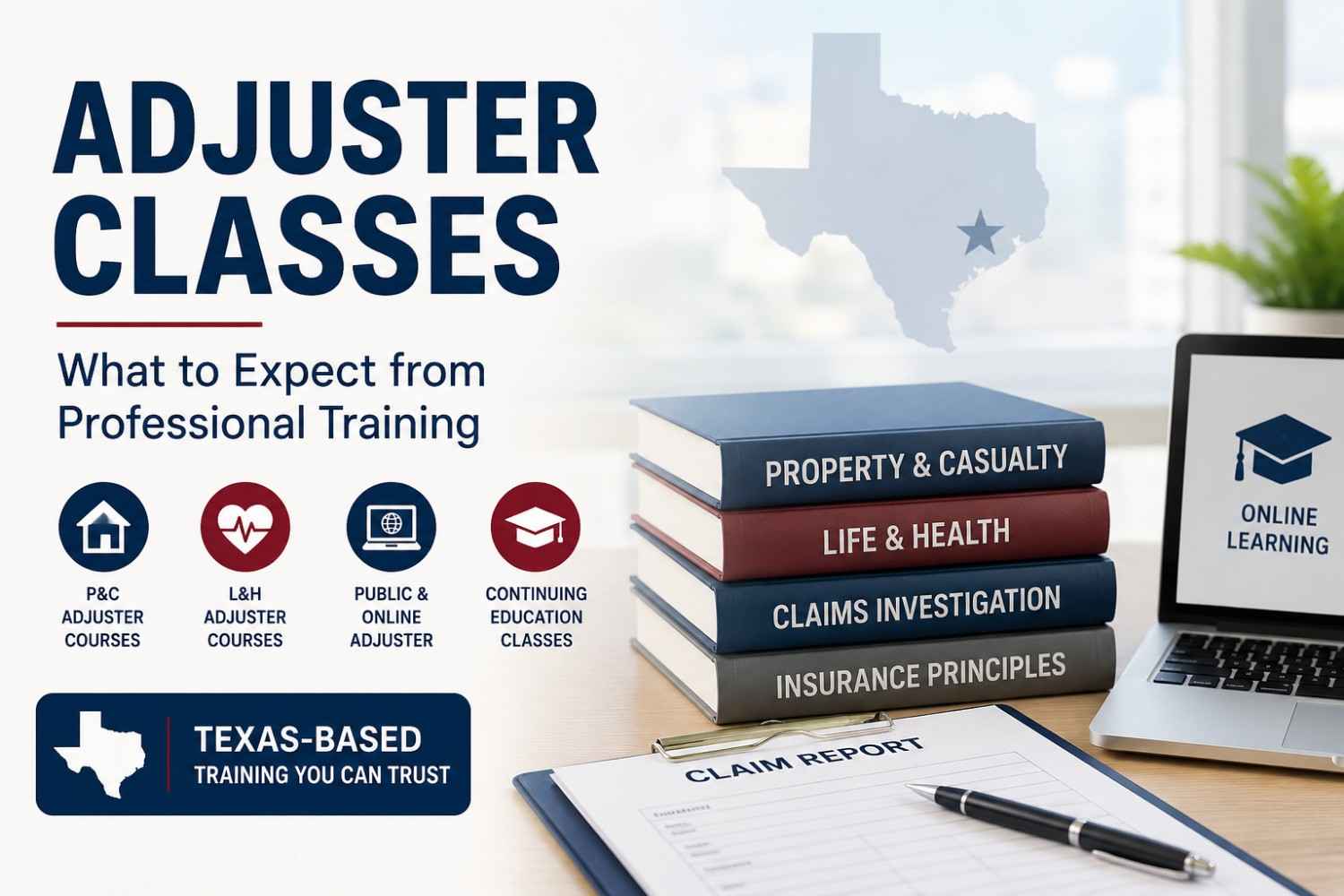
So you're thinking about adjuster classes. Good move. Here's what training actually covers: core insurance basics, real claims investigation work, and the software adjusters use on the job every single day. You leave knowing how to work a claim, not just how to pass a test.
Our Texas-based adjuster classes take you from zero experience to job-ready. New to the industry, or adding another license? Either way, you're building skills you'll actually use, not just memorizing terms for an exam.
Key Takeaways:
● Classes cover core insurance principles and claims investigation right from day one
● You get hands-on practice with the software adjusters use on real claims
● Pick from P&C, L&H, public and online adjuster tracks, plus specialty and CE courses
● Classes run across Texas, including Irving, Houston, Dallas, and The Woodlands
Building Your Core Insurance Knowledge
You start with the basics: policy types, coverage limits, how a claim actually moves from the first phone call to the final payout. Risk management, insurance law, ethics. Not exciting to say out loud, but this is the stuff that keeps you out of trouble later. Instructors lean on real examples here instead of just reading off a slide.
From there, you get into calculating losses and negotiating settlements, which is honestly where it starts feeling less like a classroom and more like the job. Most students say this is the point where they stop worrying and start understanding how a claim conversation actually plays out, whether they're on the phone with a policyholder or going back and forth with an agent.
Hands-On Claims Investigation Training
Ask anyone who's finished the program, and they'll tell you this part changes how they see the job. Gathering evidence. Running interviews. Learning to catch the small detail that ends up mattering more than anything else in the file. It's built around real case studies, not hypotheticals someone made up for a textbook.
You'll pick up on red flags too, like when a policyholder's story doesn't quite line up, and you'll see how tools like drones and aerial imaging get used to check property damage without anyone climbing a roof. And communication comes up constantly. Knowing how to talk to a stressed policyholder or a skeptical stakeholder is half the job.
Learning the Digital Tools Adjusters Use Today
Claims work runs on software now, so classes make sure you're not fumbling through Xactimate or Symbility on your first week at a real job. You'll get real time on estimating tools and on claims management systems like Guidewire, learning how claims get tracked and reported day-to-day.
There's also a bit of data literacy folded in, reading the trends a claims system spits out so you can work smarter instead of just faster. By the time you graduate, none of this software feels new. It just feels like part of the job.
Courses Offered
Here's the full lineup, depending on where you're starting from:
● Property and Casualty Courses
● Life & Health Courses
● Adjuster Courses
● Public and Online Adjuster Courses
● Limited Line Online Course
● Life Only Online Course
● Surplus Lines Online Courses
● Continuing Education Classes
Classes Near You Across Texas
Classes run in person and online across the state, with locations in Irving, Houston, Dallas, and The Woodlands, plus Arlington, Fort Worth, Garland, Grapevine, Humble, Katy, Kingwood, Missouri City, Pearland, and Plano. Chances are, there's a schedule that works wherever you're based.
From Classroom to Career
Once the core material is done, you move into field simulations and case study work that mirror what adjusters actually deal with: property damage one week, liability claims the next. This is where the theory starts to click into instinct. You're investigating, weighing evidence, and making calls under something close to real pressure.
From there, graduates tend to specialize: property, casualty, or workers' comp, each with its own pay range and career path. And continuing education isn't just a box to check. It keeps your license active and keeps you current as the industry brings in new tools, AI-assisted claims review being the latest example.
Getting Started
Adjuster classes should leave you with skills you can actually use, not just a piece of paper. Between the core concepts, the software training, and the specialization options, the whole point is getting you working and getting paid, sooner rather than later.
FAQ
Q: What will I actually learn in adjuster classes?
A: Core insurance principles, claims investigation, and the software used in modern claims work. You walk out with a skill set that's actually usable on day one.
Q: How hands-on is the training?
A: Very. Think field simulations, case study work, and real claims software, not just sitting through lectures.
Q: What can I do after finishing the program?
A: Specialize in property, casualty, or workers' compensation claims, and keep your license active through continuing education.